Narrow Lanes, Wide Smiles: A Nervous Driver's Companion to Mull's Single-Track Roads
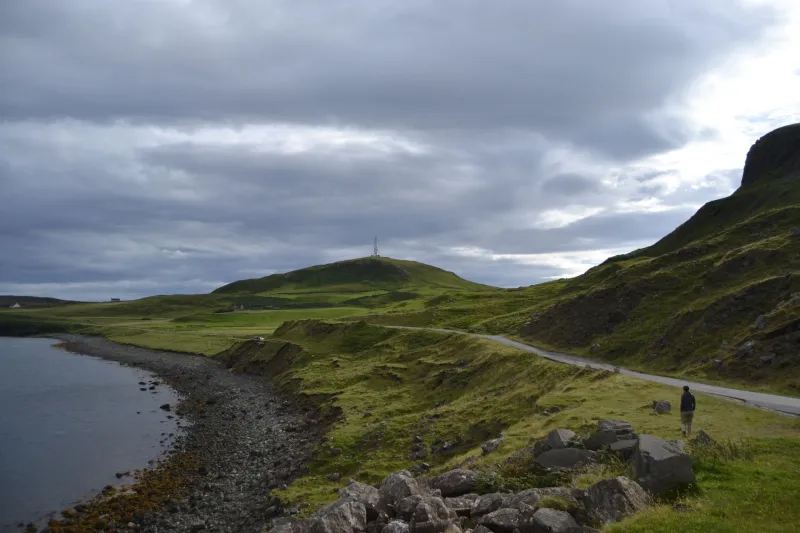
There is a particular kind of quiet that falls over a car full of people when the road ahead narrows to a single ribbon of tarmac with grass down the middle. It's not quite fear. It's more of a collective intake of breath. If that sounds familiar, you're in good company. Plenty of confident motorway drivers arrive on Mull and discover that thirty miles of single-track feels like a different sport entirely.
It isn't, really. It's just a road with a different set of manners. Learn the handful of unwritten rules, and the narrow lanes stop being something to survive and start being the best part of the day.
What a single-track road actually is
A single-track road is a normal road that happens to be one vehicle wide for long stretches, with regularly spaced passing places cut into the verge. On Mull these are usually marked by a black-and-white post, though plenty are just a widened gravel pocket that you'll spot a second before you need it.
The key thing to understand is that the passing place isn't a lay-by. It's not for parking, picnicking, photographing a rainbow or checking your phone. It exists so that two vehicles can get past each other without anyone reversing half a mile. Treat it as infrastructure, not scenery, and everything downstream gets easier.
The rules, minus the myths
Here's the version worth memorising before you board the ferry at Oban.
Keep left. Always. Even when the road is empty and the view is on the other side, drive as though something is coming.
If a passing place is on your left and you meet an oncoming vehicle, pull into it and let them through. If the passing place is on your right, stop opposite it — clearly, not half in — so the other driver can swing into the space. A brief flash of headlights or a lifted hand confirms the plan.
If you're the one who has to reverse, reverse. It's rarely more than fifty yards to a passing place, and the other driver will usually wait with the patience of someone who has done it a hundred times. Do it slowly and straight; nobody is timing you.
And a small but important one: don't stop in a passing place to admire the view, even briefly. Someone behind you may be counting on it.
Meeting a coach, a camper and forty sheep
Coaches on Mull are not the villains of the story. They're on a schedule, they're wide, and their drivers know the road better than you do. Give them room. If a coach appears and the nearest passing place is a hundred yards behind you, tuck in where you can and let it come past. Nobody will think less of you.
Campervans deserve the same courtesy, though the etiquette runs both ways — if you're the slow vehicle and a queue has gathered behind you, pull into a passing place and wave them by. This single habit does more for island harmony than anything else on this list.
Livestock is a different matter. Sheep have right of way, always, and they know it. Slow to a crawl, give them space, and resist the urge to hurry them along with the horn. Cattle are calmer still; stop, wait, and they'll eventually wander off the tarmac. Sheep grids are marking a boundary, not a suggestion — don't stop on one.
A worked example: Craignure to Salen and out west
The A849 from Craignure to Salen is a good first taste. Wide in places, single-track in others, with the Sound of Mull keeping you company on the left. Take it gently, and you'll find the rhythm: accelerate, ease off, pull in, wave, carry on.
From Salen, the B8035 towards Gruline and Loch na Keal is where the training wheels come off. It's narrow, it twists, and it rewards a driver who has stopped treating the accelerator as a personality trait. The reward is Loch na Keal on a still morning with the hills doubled in the water.
If you're heading north instead, the B8073 to Dervaig and Calgary is another classic — tight, pretty, and busy enough in July that patience is not optional. The same road in February is a different experience altogether: you may not meet a soul between Salen and the beach.
Speed, deer and the light
National speed limit on single-track may technically apply, but the sensible figure is somewhere between twenty and thirty-five, and slower in villages. Mull's roads are not the place to test a car's handling.
Red deer are the reason most locals ease off at dusk. They step out of the bracken without ceremony, often in the last hour of light, and they do not hurry. If you're driving after a long day on the west coast, take the final stretch slowly and keep your eyes on the verges rather than the sunset.
The wave, and other small courtesies
A raised hand as you pass is the island's handshake. You'll get one from most drivers and it costs nothing to return it. It isn't a rule, exactly, but it sets the tone.
Don't tailgate on single-track. There's nowhere to overtake and no benefit to sitting six feet from the bumper of the car in front. Leave a gap, enjoy the view, and arrive at Salen in a better mood than you left Craignure.
Finally, build a little slack into your day. If you have a ferry to catch, leave earlier than feels necessary. A coach, a flock of sheep and a tractor in one afternoon can add twenty minutes you didn't budget for, and the island is much more enjoyable when you're not chasing a sailing.
The slow lane is the point
Here's the thing that takes a day or two to sink in: the single-track roads are not an obstacle between you and Mull. They are Mull. The narrowness is why the island still feels like itself — why there are otters on the shore and not a retail park, why the beach at Calgary is empty at nine in the morning.
So pull in, wave, let the coach past, and settle into the pace. By the second day you'll be the one raising a hand first, and wondering why anyone would want to drive any faster.