What the Sea Leaves: A Slow Comb Along Mull's Winter Strandlines
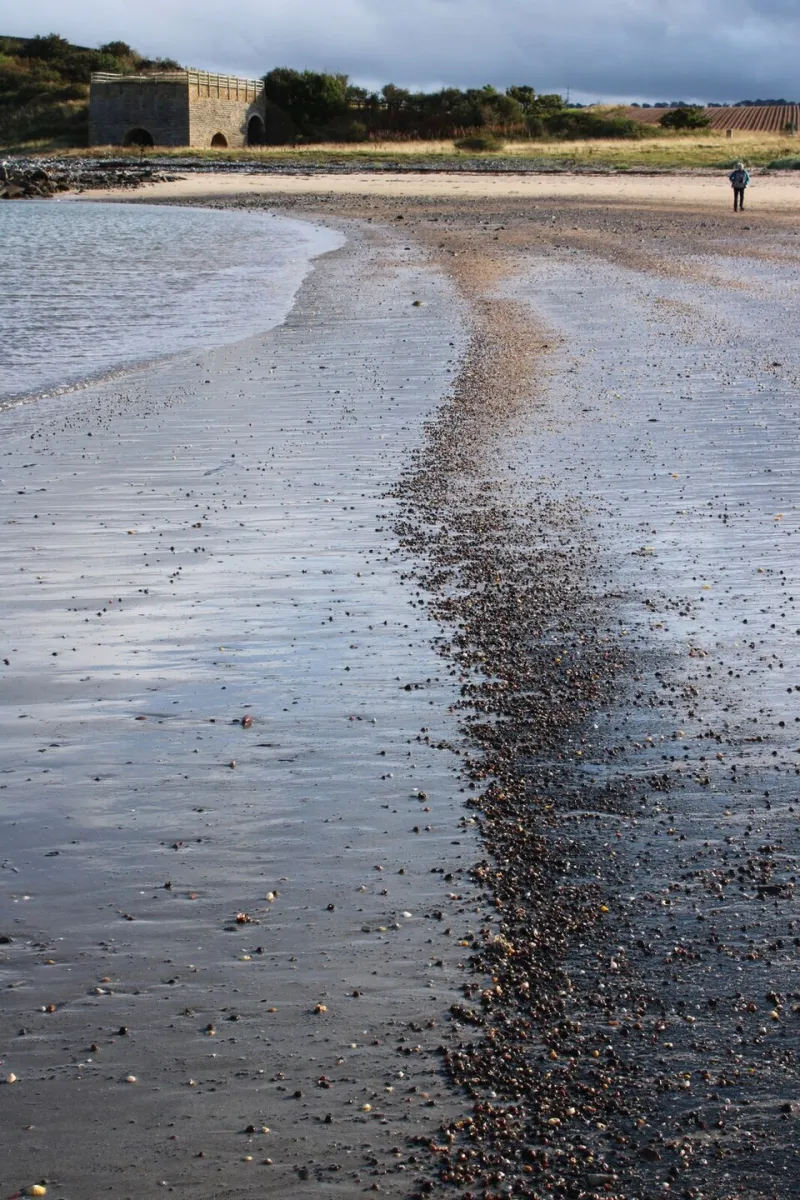
Photo: Richard Sutcliffe , CC BY-SA 2.0, via Wikimedia Commons
There is a particular kind of quiet on a Mull beach the morning after a big Atlantic low has gone through. The wind has dropped, the sand is ribbed and squeaky, and high up near the dune edge sits a fresh dark band of weed, wrack and odds and ends that wasn't there last week. That band is the strandline, and it is the closest thing the coast has to a delivery note.
Beachcombing on Mull isn't really a hobby so much as a slow walk with your eyes down. You don't need a bucket, a sieve or any kit beyond a decent pair of boots and a bag. What you do need is a bit of timing, a rough idea of which bays catch what, and enough self-restraint to leave most of it behind.
Read the weather backwards
The strandline you're looking at is the result of weather that has already happened. Winds from the south-west and west push weed, glass and timber onto Mull's Atlantic-facing beaches; a spell of easterlies will strip them bare and dump the lot on the other side. So the useful question isn't "what's the forecast today" but "what was the wind doing on Tuesday".
Give it a day to settle. The first tide after a blow tends to scatter debris in a messy wash; the next couple of tides comb it into a tidier line that's far easier to work along. Springs, when the tide range is biggest, reach highest up the beach and expose the most sand — low water on a spring tide, an hour or two either side, is the sweet spot. But do check a tide table before you commit, particularly on the long shallow beaches of the Ross of Mull, where it's easy to wander further out than you intended.
One practical note: the best line is usually the highest one, laid down at the peak of the storm. It's often within easy reach at half tide, which means you don't have to wait for the bottom of the ebb to start looking.
Bays that collect, and what they collect
Calgary Bay in the north-west is the obvious first stop, and deservedly so — pale sand, machair behind, a car park and (in season) somewhere to get a cup of tea. The strandline here can be generous after westerlies, and the walk round to the old cemetery is worth the extra half hour on its own.
Further east, Croig and Langamull are quieter, reached on foot along the coast path, and tend to hold smaller, older pieces of glass — the sort that's been tumbled for decades rather than weeks. On Loch na Keal's shore near Killiechronan and Gribun you're combing a different kind of beach: darker, stonier, more about pottery and worn ceramic than sea glass.
The Ross of Mull is where the long shallow sands live. Uisken and Ardalanish both offer big skies, wide strandlines and that slightly addictive feeling that the next patch of weed will be the good one. Ardalanish also has a working weaving mill and farm shop, which is a sensible way to end a walk. And then there's Laggan Sands beyond Lochbuie — a long, handsome curve backed by woods, with Maclean's mausoleum at one end. After a proper gale the weed line here can be knee-deep in places, so pick your way rather than plough through it.
What's worth the pocket space
Sea glass, within reason. Greens and browns are ten a penny; frosty white is common enough; anything blue is a small event. The grown-up rule is a handful per visit — enough to feel like a haul, not so much that you're strip-mining a beach that other people also came to look at.
Sea pottery is the underrated one. Patterned shards of Victorian and Edwardian crockery turn up regularly, and a bit of blue-and-white sponge print or a fragment of lettering is far more interesting than your twentieth green bottle base. Photograph it, pocket one piece, leave the rest.
Mermaid's purses are the eggcases of sharks and rays, and they're genuinely useful to record. Empty, dried cases are fine to pick up; anything with a visible yolk or an embryo inside should go back in the water. The Shark Trust runs a long-standing eggcase recording scheme, and a note of the beach, date and rough size is a small contribution to real marine science. The big pale blonde ones are often nursehound; the small dark ones usually belong to lesser-spotted dogfish. If you're unsure, take a photo and look it up later.
What stays put
Live things stay put, full stop — limpets, periwinkles, starfish, anything still moving. So do whelk egg cases (those curious spongy balls), which are often mistaken for rubbish and equally often still viable.
Big driftwood should stay too, tempting as it is. It holds the back of the beach together, it's habitat for invertebrates, and salt-soaked timber spits and corrodes a stove anyway. Small bits for a windowsill are one thing; hauling a whole trunk to the car is another.
And there are places where you shouldn't be pocketing anything at all. Parts of Mull's coast are designated as Sites of Special Scientific Interest or managed as nature reserves, and the general freedom to pick up a bit of glass doesn't extend to those. Nor does it extend to digging into dunes or machair, which are fragile and slow to recover. Metal detecting needs permission and, on scheduled or historically important ground, more than that. Anything old, man-made and interesting — a coin, a ship's fitting, something with a story — should be reported to Treasure Trove Scotland rather than quietly taken home. Mull has a long history of wrecks, and the Florencia story in Tobermory is a reminder that the interesting stuff tends to be official business.
Folding it into a walk
Strandline combing works best as half of a day rather than all of it. The Calgary circuit, beach first then the woodland path behind, is a comfortable two hours. Uisken to Ardalanish makes a fine half-day on the Ross with a shop at the far end. The walk out to Langamull from Croig, or the out-and-back to Laggan Sands, both give you a proper leg-stretch with the combing as a bonus rather than the point.
Take a cloth bag rather than plastic, gloves if you're handling unknown objects, and a flask. Then, before you climb back over the machair, turn round and look at the beach from the top of the slope. If you've left the strandline roughly as you found it — bar a few pieces of glass in your pocket — you've done it right.